

Barbara McCann may have been the first person to notice that the Federal Highway Administration had removed several safety policies from public view.
McCann worked on road safety policy at the US Department of Transportation (USDOT) for more than a decade across multiple administrations, retiring in January 2025 just before Donald Trump’s second term started. After Sean Duffy, the president’s ally and former Fox news host, took the wheel at USDOT, she became increasingly worried as the secretary appeared unmotivated to address pedestrian safety and regularly bashed bike infrastructure.
It was typical bullying behavior, she thought. “You pick someone who’s vulnerable and attack them,” McCann said. “They decided that bicyclists are vulnerable and that they could use that as a political wedge. It didn’t seem to have anything to do with actual safety.” In a country where traffic deaths far surpass its international counterparts, that could be deadly.
Shortly after he was confirmed to the post, TV personality turned politician Duffy signed orders last year to end what department officials called “woke policies” from the Biden administration and ensure that “all USDOT policies, grants, loans, and actions are based on sound economic principles, positive cost-benefit analyses, and pro-economic growth priorities”.
“Remember when Biden and Boot-edge-edge used YOUR MONEY for DEI bike lanes and climate change? THAT’S OVER,” Duffy posted on X in July, saying he had diverted $1.73bn in USDOT grants “away from Biden-era DEI pet projects” and toward roads, bridges and ports.
Amid that push, the department and its sub-agencies have been scrubbing information about safety measures from government websites that officials had deemed effective, and focused on building policy aligned with a rightwing, anti-immigrant agenda instead of research.
The department removed five suggestions from a “proven safety countermeasures” list by the Federal Highway Administration: bike lanes; road diets, which involves reducing car lanes, often to make space for a bike or bus lane; plus three speed management tools, including automated camera enforcement and variable speed limits. Webpages that provided information about pedestrian and bicyclist safety have also been deleted. Improving safety is listed in one order as a benefit USDOT “may include” in decision-making “to the extent practicable”.
Duffy has vowed that his agency is “committed to making our roadways safer and bringing down the number of fatalities”.
“We’re taking a closer look because the Trump Administration supports transportation systems that benefit Americans, including the nearly 80% who rely on cars to get where they need to go safely and efficiently,” a USDOT spokesperson wrote in a statement.
But transportation safety experts who spoke with the Guardian, including one former USDOT official, are raising concerns that federal officials are ignoring decades of science-based evidence to put a car-obsessed Maga ideology in the driver’s seat, which could make getting around more dangerous for everyone.
Roads in the US demonstrate an unwelcome kind of American exceptionalism: they are deadlier for the millions who use them every day than those in dozens of other high-income countries.
Duffy highlighted the scale of the problem in his department’s 2026 safety strategy. “Despite encouraging trends over the past few years, we estimate that 36,640 people died in motor vehicle crashes in 2025”, Duffy wrote in a letter leading the document. “Millions more were seriously injured.”
But experts say the actions he has taken aren’t in line with the evidence of what keeps roads safe.
After Duffy’s “DEI bike lanes” remark, McCann checked FHWA’s website and saw that several “proven safety countermeasures” had been deleted (an internet archive maintains the previous list here).
For McCann, the purge of science-backed strategies to address speeding – a key factor in nearly a third of fatal crashes in the US each year – was “just gobsmacking”.
One of those tools to manage speed, automated speed cameras, capture the license plate of a vehicle exceeding a posted speed limit by a significant amount and mail a citation to the registered owner. A growing number of communities are installing the technology on their streets – often in school zones – because they work, as FHWA’s website previously said.
Jessica Cicchino, a senior vice-president of behavior and infrastructure research at the Insurance Institute for Highway Safety, a non-profit research organization, said it was concerning that speed cameras, which are “really effective at bringing down serious injuries and fatalities”, are no longer promoted by federal authorities.
“If you really believe as an agency that your job is to make safety a priority, then we need to have those resources that tell states and cities the best ways to reduce fatalities on the roadway,” Cicchino said.
The number of people killed by drivers while walking and biking has risen sharply in recent years, even before Duffy took over the agency. Pedestrian killings jumped 72% between 2009 and 2024, while cyclist deaths increased 73% from 2010 to 2024, according to federal data Cicchino’s organization gathered from USDOT.
But she noted another issue that is troubling researchers: instances of federal databases disappearing with little explanation as to why. That includes the Highway Safety Information System (HSIS), which is maintained by the FHWA and features complex data on traffic crashes and roadway characteristics in several states. It was taken down last year and is still missing.
In a statement provided to the Guardian, FHWA said the website hosting HSIS data “was down last year for a few months – while we updated guidebooks”, but remained “available upon request”.
When the Guardian asked officials to share strategies aimed at fulfilling USDOT’s stated mission to build the safest transportation system in the world, a spokesperson pointed to Duffy’s “freedom to drive” initiative. The plan, launched in April, aims to reduce traffic congestion by “maximizing roadway capacities”. Duffy sent a letter to state governors calling on them to enact his plan.
***
Duffy’s most publicized road-related campaign at USDOT is a crackdown on foreign-born truck drivers. Earlier this year, the department issued a new rule that disqualifies truck drivers without US citizenship or permanent residency from getting or renewing their commercial driver’s licenses (CDLs).
The goal, according to Duffy, is to make the licensing process more stringent and subject to federal immigration enforcement to prevent alleged “dangerous foreign drivers” from operating large trucks on US roads.
Critics say the effort has racist undertones and is guided by the Trump administration’s nationwide effort to target immigrants, not by data-based safety goals.
“While DOT premised its rule on safety, its own data indicated that the CDL holders excluded by the rule (immigrant drivers) were involved in fatal collisions at a lower rate than CDL holders who are not excluded, meaning the rule would worsen, and not improve, safety,” the AFL-CIO, the largest federation of labor unions in the US, wrote in a March letter to Congress.
To justify Duffy’s new road rules, department officials cited 17 fatal crashes in 2025 they claim were “caused by actions of non-domiciled CDL holders whose fitness could not be ensured”. Those collisions resulted in 30 deaths, 0.08% of USDOT’s estimated road deaths last year.
“I think it’s just par for the course in looking at immigrants as a bogeyman”, said Jesus Barajas, an associate professor in the environmental science and policy department at University of California, Davis.
Barajas studies transportation equity and mobility justice and said USDOT’s vehement rejection of “equity” as a factor in safety planning puts already vulnerable pedestrians and cyclists at greater risk.
“We know that the safety problem is a problem of equity because it tends to be communities of color and low-income communities that are most affected,” he said. “When you’re shifting your investment dollars into prioritizing vehicles and eliminating barriers [so] that cars go faster, now you’re prioritizing only the vehicles at the expense of other people on the roadways.”
McCann says she sees similarities in how Duffy’s USDOT is targeting both immigrant truck drivers and bike lanes, which she views as another way for the Trump administration “to express their dominance over vulnerable populations”.
“That’s just a classic feature of the autocratic playbook,” she said. “They pick scapegoats and go after them. That has absolutely nothing to do with safety.”
The downstream effects of Duffy’s hampering of speed management and bike and pedestrian safety infrastructure will come down to states and local governments, McCann said, since they actually build and maintain those projects.
“The question is whether the states go along with this and cancel projects and submit to this ideology, or whether they keep following the science and the data and the facts,” she said.
The impact is felt beyond the US. This July, the United Nations general assembly adopted a declaration that “preventable deaths and serious injuries are not an acceptable cost of mobility”. The resolution called on member nations to recommit to a goal of halving global road deaths by 2030 and work “to provide access to safe, affordable, accessible and sustainable transport systems for all”.
The vote was 162-1, with the lone opposition from the US, whose delegate blasted the resolution as “a backdoor vehicle to enforce global climate pacts and top-down environmental restrictions on freedom of mobility”.
***
Duffy has been trotting out figures to justify his approach. The department claims that traffic deaths “fell to record lows in 2025”, though the agency’s own historical data contradicts that.
USDOT estimated 36,640 people were killed in collisions last year. That’s the fewest deaths since 2019, but far from the lowest number on record. Looking at the figures from 2010 to 2025, fatalities have increased 11%.
Officials also touted the “second-lowest traffic fatality rate in recorded history at 1.10 fatalities per 100m vehicle miles traveled”.
David Zipper, a transportation scholar, believes USDOT is counting the wrong way, arguing that deaths per capita (100,000 residents) provides the full scope of risk to the public. That metric also places the US death rate far higher than many peer nations. He noted another gap in the administration’s safety strategy: vehicles are getting larger and killing more people.
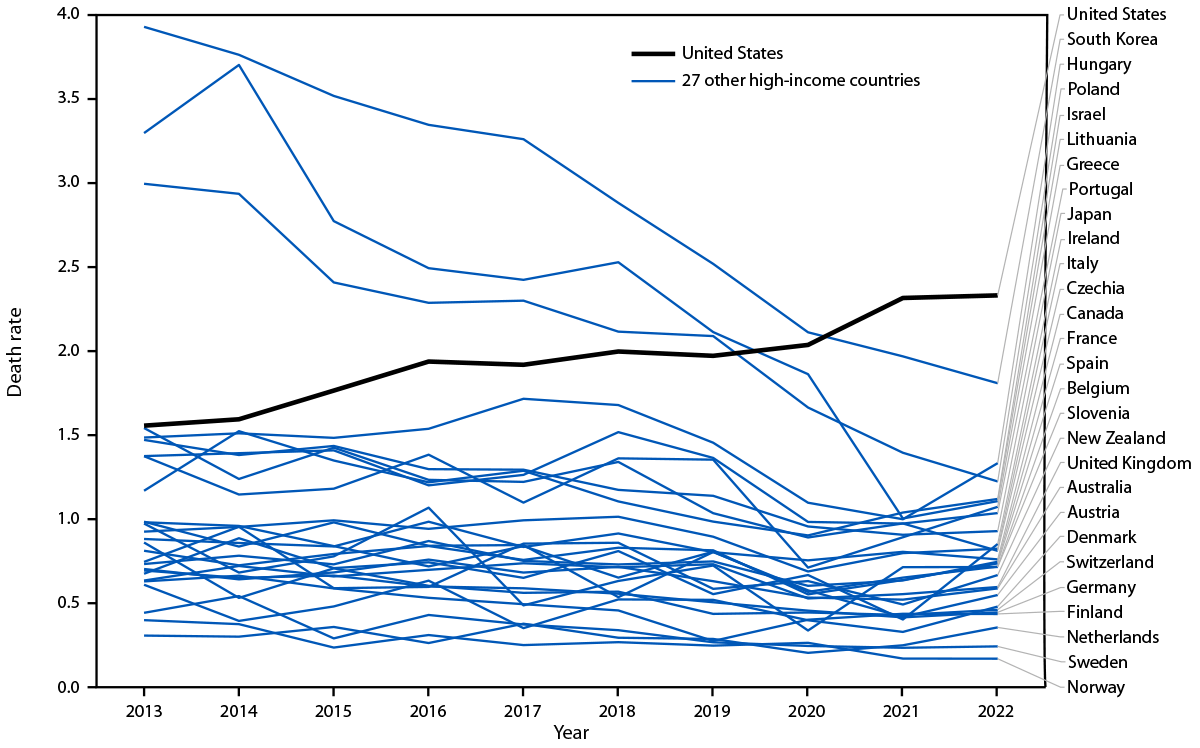
Duffy’s safety roadmap includes broad goals of making vehicles safer by integrating new technology and supporting the “safe deployment” of autonomous vehicles, but does not mention any plans to look at regulating vehicle size.
The USDOT under Duffy has not noted successful examples of the countermeasures it removed for alleged further review.
Hoboken, a New Jersey city with about 60,000 residents, has not had a single person die in a crash on its streets in more than nine years after adding bike lanes, reducing space for cars and lowering speed limits on their local streets. And New York City last year marked the lowest death toll since it began keeping records in 1910, citing the city’s “dramatic expansion of protected bike lanes and newly pedestrianized space”, along with automated speed cameras, improved bus transit and focused police enforcement.
In contrast, Duffy’s Department of Transportation has limited funding for speed camera and pedestrian safety projects and attacked the previous administration for its support of bike infrastructure, which the secretary dismissed as “crap” and “DEI pet projects” from Pete Buttigieg, his predecessor.
“Biden and Buttigieg failed to thoroughly investigate the negative impact of bike lanes in their rush to achieve their radical social and climate goals,” a department spokesperson said in a statement, claiming roads redesigned to add bike lanes were “negatively impacting small businesses by eliminating parking, disproportionately hurting the elderly or disabled, and disrupting traffic flow”.
That highlights the tradeoff at the core of the conflict over public roads: making them safer requires building them in a way that compels drivers to slow down. Duffy’s actions suggest it is not a tradeoff his department is willing to face.
“What Duffy really reflects is this Maga idea of freedom,” said Zipper.
“[It’s] all about: ‘Don’t tell me what to do. Whatever I want to do in my car, however I want to drive it or whatever kind of car I want to drive, the government and nobody else can get in the way of it.’”
