
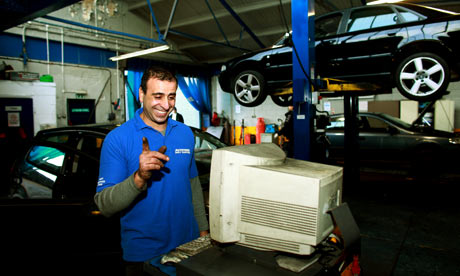
Selim Mustafa is holding court, appropriately enough, in the exterior courtyard of Autoteks, his garage and MOT test centre in north London. It's a chilly morning and there's more than an hint of the Michelin Man about him, wrapped as he is in a black hat and coat worn over a navy boiler suit, followed by a check lumberjack shirt and, one suspects, several layers under that.
He peels off an engine grease-coated surgical rubber glove and, grinning jovially, offers a large hand in greeting. His fingers, like a mechanic's badge of honour, are calloused and blackened with years of accumulated motor grime. "It's very hard," he sighs. "Even if you wash and wash, they'll still be dirty. It just gets ingrained."
Despite this he doesn't look in the least bit concerned about the state of his hands, although someone obviously cares enough to have left a pot of hand cream in a metal locker otherwise full of mechanical bits and bobs.
"Ha ha, yes," Mustafa admits a little sheepishly. "The mechanic's secret."
Having crunched through the broken glass-strewn streets of an Edmonton industrial estate to get here, it's a relief to be in the hubbub of the workshop. Burly mechanics with clipboards bustle back and forth between teetering stacks of spare tyres on one side of the yard and covered bays on the other.
A dozen or so cars are parked in front of us in an unfeasibly tight grid, like tiles in a sliding puzzle. In the far corner, a snack caravan does a brisk trade in hot tea for waiting customers. This is not the most alluring part of town but that doesn't seem to stop the punters coming here.
"I bought the place six years ago," he says as we tour the covered bays, where half a dozen mechanics are industriously working on a row of vehicles. "I always used to bring my car here for its MOT. The owner was quite old … I always said to him, 'if you ever wanna sell it, let me have first option'. Then it came along so I bought it." There is a look of genuine wonderment on his face as if, even now, he still can't quite believe it's all really his.
Next to us, in the testing bay, a mechanic is rhythmically revving and braking at the wheel of a silver Audi that has its front wheels parked on two rollers. "He's checking the efficiency of the brakes," Mustafa explains. "Over here, he's testing the emissions."
Most of the vehicles are wired up to various computers and other testing equipment. Nowadays, apparently, a large part of a mechanic's work is electronic- and diagnostics-based. "When I started, cars had points and plugs," he says, a little wistfully.
In a side office, he unlatches a black briefcase, concealing a small device that could easily be mistaken for a handheld video game. But it will connect to and diagnose a fault on any model of modern vehicle. "The car is now a computer," he explains. "A car will know if its brake pads are worn, if the tyre pressures are low."
Autoteks takes in about 25 cars a day, a brisk turnover that reflects not just Mustafa's good reputation but also many people's present need to make do and mend their existing vehicles. Interestingly, he thinks the government's £2,000 scrappage scheme, to encourage motorists to trade in their old cars and buy new ones, has done little to dent his business. "People don't want to get into another £10,000 of debt," he says. "They can't even service the debt they've got."
Even so, 25 cars a day seems like a lot of work and pressure. How much time does his team spend on each car? "It takes as long as it takes," he says, shrugging. "You can't really put a timeframe on it, though I suppose roughly about 45 minutes. And the tester can't be disturbed." This is, apparently, a key condition of the MOT test.
"We could get inspected [by the Department for Transport] at any moment, so we've got to be very, very careful," he points out. "If you get shut down, a lot of people lose their livelihoods."
Along with that, of course, comes the not insignificant responsibility of ensuring his customers' vehicles leave the workshop in a roadworthy condition. More than 2,500 people died on the UK's roads in 2008, a figure which, while much reduced in recent years, represents a sizable proportion of the country's accident-related fatalities.
Isn't there some element in these statistics that sometimes keeps him awake at night?
"There is always a worry that someone might not have done their job properly," he concedes, as his mobile phone goes off for one of umpteen times during our conversation.
"It is a lot of responsibilty. You've got two tonnes of metal that needs to stop, and stay on the road, basically under control, and yes, if you miss something it could be dangerous."
At the far end of the shed is a sunken vehicle inspection pit; I creep down the steps and peer up at the undercarriage of a white van parked over my head, taking care not to sneeze for fear of being engulfed in soot and rust.
"When it really rains and this fills up with water, we use it as a swimming pool," Mustafa says merrily.
On the face of it, he has plenty to be cheerful about. Having been an avowed petrolhead since his childhood growing up in nearby Wood Green, having his own garage was the realisation of a dream he held long before first setting up as a mobile auto repairer at the age of 19.
In those days, he also had a talent for creating work on cars, not just fixing them. "I did used to get in trouble with cars when I was young," he admits, a little bashfully. "I was a bit of a scallywag … took my dad's car when I was 11 and smashed it into three other cars. So my interest in them goes well back."
We go back out into the courtyard, where Mustafa has been summoned to speak to a customer. The man looks suspiciously at my voice recorder. "He thinks you're from the ministry," wisecracks a mechanic, disappearing into the tyre shed.
In truth I do feel like an inspector of sorts; and it brings to mind something I'm keen to ask about the motor industry generally. Before setting up my meeting with Mustafa I took the precaution of speaking to some of his customers to make sure he was a respected practitioner. But why, despite all the technological advances and the rise in standards generally, is the motor industry so cursed by the image of conmen and untrustworthy wide boys?
Word of mouth
He pauses to consider this. "You do hear things," he says, darkly. "I can't name any names but, you know, you hear even of main dealers … there was a company that was doing free MOTs and then failing things on cars that shouldn't have been failed. And I've heard of engine companies up to all sorts of tricks."
I consider pressing him further about this but I can sense he is already picking his words carefully, reluctant to say anything he might regret. He agrees, though that the actions of a few continue to give the trade a bad name.
"Not everyone wants to do that," he protests. "Someone like me, I'm in it for the long run, I'm not in it to make a quick buck. Some places don't care about their customers; I don't know how they get them, probably through advertising, offering a certain price and then changing it when you get there. We couldn't survive doing that. It just wouldn't be …" his voice tails off.
To that end, Mustafa prefers to rely on the word of mouth testimony of his customers, effectively letting them do his advertising for him. "When you get recommendations from customers, you know you're doing something right," he says. "It's harder to do a job properly, but it's more rewarding."
Before I go we have a quick nose around the small back office behind the reception area, which is sparsely furnished except for a photograph of his two young sons, both in Arsenal shirts, sitting on top of a computer. "We're all big Arsenal supporters in our family," he says.
Doesn't that ever cause problems round here, I wonder, mindful that his garage is situated just five minutes' walk from White Hart Lane, the home of Tottenham Hotspur, Arsenal's north London arch-rivals?
Mustafa scratches his head for a moment. "Someone did mention something to me the other day," he says, pondering the workshop's smart yellow, blue and grey interior paintwork. "The guy who owned the place before me was a Spurs fan. You know their old kit? It was grey, blue and yellow. He's only gone and painted the whole garage in their colours."
Any plans to redecorate? "Oh no," he says hastily. "I wouldn't wanna lose any trade.
CV
Pay As the owner of the garage, Mustafa pays himself about £60,000 a year. "The mechanics are on about £15,000."
Hours "Usually I get in at 8am and finish at 6pm."
Work-life balance "I work six days a week and sometimes I have to stay late. But I've got two boys at home [aged four and seven], so you've got to cut off, have your family life as well."
Best thing "Being my own boss."
Worst thing "When you take on a job and it is a bit bigger than you think, and you've got loads of work booked in for the next day and you've gotta stay and finish it."
Overtime
Selim's own car is a BMW 6 Series 'Anything German; they're more reliable – you don't want to be working on your own car.' Selim unwinds by go-karting 'A group of us have been doing it for years – it's like a league. At Selim's garage you won't find pictures of topless girls on the walls 'I didn't want them. A lot of our customers are women; I think it's quite offensive.' It's Selim's birthday this week 'I'll be 39 on Tuesday.'
