
There was a time when the auto industry viewed green issues as an eccentric distraction. But the world's top carmakers are now falling over each other to reveal their environmental credentials - and tension over "clean fuel" has broken into the open.
Toyota and General Motors are engaged in a furious row over who is making more effort to develop battery-powered cars. Each believes it is being unfairly put down by the other.
The Japanese firm can justifiably boast that it was the first to turn an electric hybrid vehicle into a successful mainstream product - sales of the Toyota Prius have topped a million worldwide.
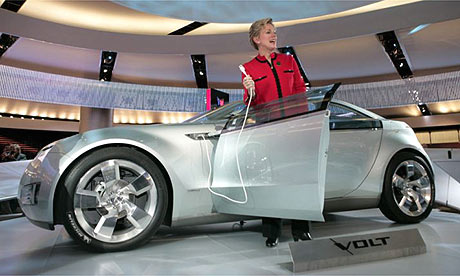
But GM stole the limelight at this year's Detroit motor show by unveiling a long-term concept called the Volt - an electric car with a generator on board able to recharge its battery on the run. Targeted for completion by 2010, this would solve a key problem for plug-in cars - the fact that they can typically only go 40 or 50 miles before needing a recharge.
At the Frankfurt motor show this month, GM's vice chairman, Bob Lutz, suggested that the success of the Prius had overshadowed the strides made by Toyota's rivals.
"People have a very simplistic way of organising things: Toyota, because of the Prius, are saving the planet from certain destruction, whereas General Motors, which produces the [Hummer] H2, is the antichrist that's trying to plunge us into the abyss," said Lutz.
He complained that such perceptions were "totally ridiculous", adding that "the only way we can get out of that is by being more environmental and leading with more environmental technology than Toyota."
GM and Toyota have a history of locking horns: the American firm lost its long-held top spot as the world's biggest carmaker to Toyota this year. GM has made huge losses in its home market as Asian rivals have snapped up market share.
The technological challenge in the electric car sphere is twofold. Batteries need to be sufficiently powerful to cover plenty of distance. They also need to stay cool, to avoid a tendency to overheating found in many types of battery. This caused problems in another industry this year when Dell recalled more than 4m laptop computers because their power packs had an occasional tendency to burst into flames.
Toyota is working on hybrid pickup trucks and sports utility vehicles, which would require more powerful batteries than those in the Prius. But a report in the Wall Street Journal this summer suggested that these had been delayed for a year beyond the present target date of between 2008 and 2010 due to overheating concerns.
This industry leak was swiftly denied by Toyota. Its US communications chief, Irv Miller, wrote on a company blog that it was "curious and perplexing" to suggest the timing of a vehicle had slipped back when a schedule had not been "finalised and published" in the first place.
Miller subsequently took aim at GM, pointing out that the technology behind the Volt was merely a concept that was still years from being perfected.
"Keep in mind that the advanced lithium-ion batteries that the Volt would use, batteries suitable for the long-term rigours of everyday automotive use, don't exist," he wrote.
Driving the industry's momentum is the price of petrol, which has been rising by 10% annually since 1999. Motivated by thrift rather than environmental conscience, American motorists want fuel-efficient or hybrid vehicles - and the industry has little choice but to respond. Sports utility vehicles are no longer universally viewed as aspirational - at auctions, the price of a used SUV has fallen since 2000.
Walter McManus, director of the automotive analysis unit at the University of Michigan, believes cash-strapped American automakers see batteries as a potentially bright future.
"They're thinking about it strategically. They know that in the short run, it's going to cost a lot and it's going to need research funding from the department of energy. But it is a way to reduce our dependence on oil," he says.
There is, however, a downside to electric power. If every car on the road switched to batteries, national grids would be unable to cope. To be truly environmentally friendly, motorists would have to charge up at night - when demand for electricity is lower.
"At the peak, the demand for electricity is met by high-cost sources," says Dr McManus. "Everybody would have to charge up at night - and even then, you'd have different time windows to cope with in California, New York and Texas."
