
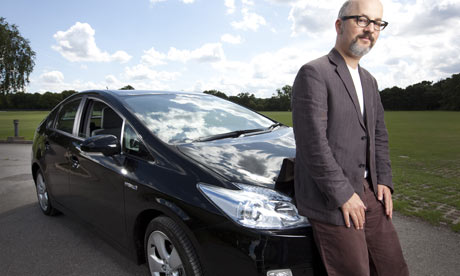
It's nearly a decade since the original Prius introduced hybrid petrol-electric cars to the UK in 2000. Produced in Japan, the Prius - like its main rival by Honda - used a battery and electric motor to recover energy wasted from braking and rolling down hills. The result: emissions around a third lower than a conventional petrol car. Although Toyota's car was not an overnight hit with the British public, endorsements from Leonardo DiCaprio and other celebrities coupled with an increasingly enthusiastic motoring press helped the company to sell over a million worldwide. Following the Prius' success, other car-makers jumped on the hybrid bandwagon, including Ford, GM and the Toyota-owned Lexus brand.
But hybrids are not the only route manufacturers have been pursuing on the road to a low-carbon future. British and American drivers have been able to buy 100% electric vehicles since the late nineties — most notably the Ford TH!NK City in the UK and GM's EV1 in the US, which became the subject of the 2006 documentary, Who Killed the Electric Car?
In the UK, the electric trailblazer has been the G-Wiz, a tiny Indian-built car popularised by London-based distributor Goingreen. While Goingreen has only sold around 1,000 G-Wiz models, the car became an iconic vehicle that people loved to praise (Boris Johnson is a fan) and mock (BBC's Top Gear has crashed and detonated several).
Major car-makers have flirted with selling a new generation of electric city cars to the British public for several years - see the Smart ForTwo ed and Mitsubishi i-MiEV — but their cars are still yet to reach the market. However, the image of electric vehicles as dowdy "Noddy" cars has begun to change, due to the advent of luxury electric sports cars such as California's Tesla Roadster and the British-designed Lightning GT.
Other green car developments have arrived. Since 2007, led by VW and its BlueMotion Polo, all the big car-makers have created "eco marques" — versions of their existing cars, but tweaked for efficiency with better aerodnynamics, gearing and other measures — under names such as "ECOnetic" and "Blue Lion". More prosaically, last year saw a UK trend towards smaller cars with lower emissions: the small car sector was the only one to see growth in September.
This year, Honda launched its Insight — the cheapest hybrid in the UK so far at £15,490 — while next year GM hopes to reverse its fortunes with the Volt hybrid, which will be branded the Vauxhall Ampera in Britain. Next year will also see the first hybrids made in Europe, plus the arrival of a plug-in version of the Prius capable of travelling further on pure electric power.
While alternative fuels like biodiesel and hydrogen are still in contention, electric vehicles are increasingly seen as the endgame for green cars. Powered from renewable sources, they're theoretically emission-free to run, while political backing from Gordon Brown to Barack Obama, £5,000 grants for buying one from 2011, and the promise of electric Minis may be enough to win the public over.
