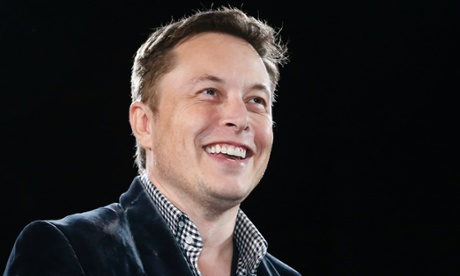
On Thursday night, Elon Musk announced a new two-motor car that everyone is interested in. It parks itself and can turn on its own air conditioning, sure, but people are interested in it because Elon Musk said it’s interesting – or at least because he teased on Twitter that he was about to “unveil the D”, which made people laugh. (He said it made him laugh, too, which is probably true, but maybe not.)
Sometimes the marketing is only a man.
Such men come along every so often: an iconoclast with so much personal presence, so much audacity for “disruption” that it’s said they can build an entire revolution on the weight of their own shoulders – and sometimes they actually do. Their names resonate through the masturbatory websites of marketing gurus: Thomas Edison. PT Barnum. Henry Ford. Howard Hughes. They all dominated, even if they were all a little bit crazy, because they started from scratch and were stubborn enough to see it through. Such tenacity is inherently selfish, an ego trip that can shape industrial history.
Musk has made his car company – and his space company – all about himself. He has bought into – and sold – his role as the modern day Tony Stark, the inventor who built and wears the only version of the Iron Man suit he invented all by himself.
I have requested many interviews with the many employees of SpaceX – engineers, retired astronauts, thruster designers The response has almost always been: Elon or nobody.
Musk does the press conferences after his rockets launch. He discusses his own burial on Mars. He discusses his commute and he walks people through the details of his Tesla electric vehicles, as he did on Thursday night. “This car is nuts,” he said at an airport hanger in Los Angeles. “It’s like your own personal rollercoaster.” These are his companies, his rides, his shows – Elon Musk, he will tell you, is the basis of their rise or fall. None of which is true, strictly, but it makes for flamboyantly cool theatre.
In a way, this is smart: In a world awash with too many “brands”, every product and service has a public face (often behoodied and incredibly boring), a Twitter account (often with jokes about as bad as “the D”, and not in reference to a dual motor), and an office-full of half-bright coffee junkies trying desperately to elevate their “product” above the marketing volume of modern media, social and otherwise. You can hire a celebrity to promote your product, to a typical eye roll, they know, or you can make a celebrity of your founder and try to use that, and your product, to cram change down an entire industry’s throat.
Iconoclasts are great avatars for disruptive technology, as long as they aren’t as pointlessly and brashly disruptive as, say, Richard Branson.
Which is why Musk’s aggrandizing, self-referential ambition is also kind of stupid. Any marketing operation that relies on a single person is inherently risky. One misstep from a public figure CEO – a DWI, a divorce, a domestic violence incident, a photo of the actual “D” – can imperil the entire operation. The need to disrupt an existing marketplace always generates bad feelings, and entrenched businesses can easily use an iconoclasts’ quirks against them when bidding for contracts, testifying before Congress or snarking at them in marketing campaigns. Taking a risk on a new invention is bad enough; taking a risk on a flaky billionaire is worse.
Flaky millionaires can help sink a company. Branson, for example, has embarrassed his own engineers – even if he does promise them unlimited holidays – by over-promising space flight to tourists and to public officials who handed him tax breaks. Even if his suborbital spacecraft fly, Branson’s bragging has highlighted the years of delay and uncertainty. The space industry is littered with wealthy owners, like Dallas’ Andrew Beal, who steered their companies into extinction.
We can admire Musk for taking on hard engineering challenges and proposing novel new approaches to solving them, but admiration can’t lift him – or us – into space. His cars will explode after impact or they won’t; his rockets will launch or they’ll crash; his Tesla D will delight or it will disappoint – and all the pretty words in the world won’t change those basic acts of physics.
Sometimes the marketing is the man, but the company is still the thing. Even if the thing is just “the D”.
