
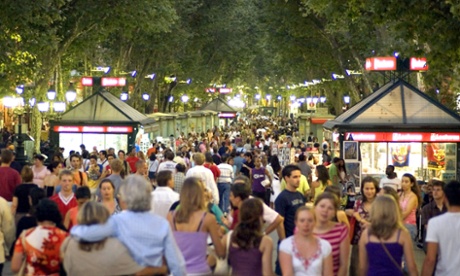
This week we have been investigating the role and impact of cars in cities: congested roads, urban motorways, creative reuse of carparks and petrol stations and how some cities are discouraging car ownership. What does the future hold next for urban transport?
We invited our readers to participate in a debate on whether streets should be pedestrianised and cars banned from city centres. We had four experts on hand to answer questions: David Sim, creative director of Gehl Architects; Paul Watters, head of roads policy at the AA; Adam Greenfield, senior urban fellow at LSE Cities; and Patricia Brown, Director of urban affairs consultancy, Central, who wrote a piece earlier this week on why the car must "no longer be king" in cities.
 Guardian contributor
 Hi Patricia! Loved the piece. I contributed yesterday's piece on Helsinki's plan to rethink public transit, and I too am looking forward to digging in to this knot of issues.
Guardian contributor I should say a bit about who I am so folks have some context. Broadly speaking I come from a technological perspective — my first book, "Everyware," was on the colonization of everyday life by information processing, and I've continued to write about these issues in "Urban Computing and its Discontents" and "Against the smart city."
But I've also worked in the sector, as among other things Nokia's head of design direction for service and user-interface design, and I like to think my skepticism regarding technological solutionism is intimately informed by this experience.
In general, I strongly believe in pedestrianizing cities wherever possible, but I'm not an absolutist on the question — and despite my skepticism, I think networked information technologies will have a significant role to play in developing new, cleaner, safer and more *urban* forms of urban mobility.
 Guardian contributor
 Hello my name is David Sim.
I am Creative Director at Gehl Architects, based in Copenhagen.
I suppose I was asked to participate because Gehl Architects focus on the pedestrian experience – which has been – and still is – often forgotten in the planning process.
I think the question posed by our friends at the Guardian is of course a bit of a provocation – I mean car-free is a bit extreme. But if the question helps us talk about this … let’s get going!
Guardian contributor Saying that I don't own a car.
I grew up driving everywhere and where the car was the epicentre of family life but moving to Scandinavia has changed that.
It's not about not having a car - though that does save me a huge amount of money which I can spend on other stuff.
It's about having great alternatives.
It's about having walkable and bike-able streets and an integrated transportation system.
 Guardian contributor
 Hi Paul from the AA here.
We don't think cars should be banned form cities - but perhaps they can become redundant in cities as seems to be happening organically.
LEDLAMP comments:
Anyone who has walked along the Marylebone road would agree that as long as motor vehicles are powered by the internal combustion engine we cannot improve the quality of life in big cities like London. They are noisy and dangerous to other street users. They produce soot particulates, noxious gases and greenhouse gases.
I often go to London but eschew the tube and motorised traffic. Instead, I mostly walk with the aid of a small London A-Z, taking all the side roads and walking through parks. Walking is quick and easy and amazingly interesting, discovering out of the way restaurants and pubs and quietly observing the architecture. Away from the main roads the air is much fresher and it is quiet. Yet there is still so much going on. Think of the walk along the South Bank.
The other day, I was in Carleton House Terrace at the Royal Society. I left and walked down the Mall, across Trafalgar Square which is a beautiful spot but thoroughly ruined by the traffic. It is somewhat improved by the pedestrianised section in front of the National Gallery, however, thanks to Ken Livingstone.
I walked on up the Strand and left into the Aldwych, Kingsway, Southampton Row and right into Guildford Street past Great Ormond Street Hospital. There you find yourself in quiet Corams Field and Brunswick Square Gardens. When you finally emerge on the Euston Road, opposite St Pancras, you realise just how unpleasant cars and lorries have made our lives.
I believe London and all big cities can never be great places to live, work or play until we replace this outdated mode of transport. We now have plenty of alternatives such as electric vehicles but, best of all, I love the experience of walking in the city and only then, as Will Self often remarks, can you properly experience it.
As Lewis Mumford once said, ‘Restore human legs as a means of travel. Pedestrians rely on food for fuel and need no special parking facilities.’
 Guardian contributor
 Sounds great. I ran the organisation that initiated what became 'Legible London' - the blue 'wayfinding' signs and finger posts. Our vision was to 'give people the confidence to get lost safe in the knowledge you can be found again'. At the time London had no consistent mapping or signs so visitors and (some) Londoners stuck to the main streets - which are not so great because of the car dominance. In fact, it was also a safety issue as some places were so overcrowded pick pockets had a field day.
Guardian contributor I tend to agree fairly strongly, but would add that as far as I'm concerned, the problem isn't even simply the internal combustion engine. You could replace every vehicle on the road with a clean, near-silent electric equivalent and many of the issues presented by the car would still remain.
For example, the appalling rate of injuries and fatalities every society in the world is apparently content to absorb as the cost of automotive freedom; for example, the ways in which (as you've pointed out) high-speed vehicular traffic makes public space inimical to the pedestrian; for example, the degree to which traveling by car deprives the rider of the sense of the city.
These are all design issues, design challenges, and I believe that they can and must be addressed in the development of new modes of personal transportation. The car, particularly the privately-owned car, strikes me as simply a hundred-year plateau in the evolution of human mobility.
Chris Michael asks:
Hi David, to build on your idea of the car as epicentre of family life – isn't ferrying the kids around on public transit impractical? I don't know many families who don't eventually cave and buy a gas-guzzler. Walkable and bikable doesn't work if you've got three kids under 5. What's the solution?
Guardian contributor OK family life - a good point.
Many families here, do thrive without a car. The combination of cargo-style bikes, pram and family friendly public transport and generous family-orientated ticketing can help.
A recent study here showed that children who cycle or walk to school perform better academically than those driven. The active children arrive at school alert while the driven children are passive.
We've struggled with the decision to keep our car. We don't really need it most days (cycle/walk/bus to work and nursery with our son). When we do need a car for longer journeys, the issue is a safe car seat. We currently use a rear-facing seat (good to 4 years old) that can't be easily lugged around, which makes using a car share difficult (our nearest one is several blocks away), and we refuse to compromise our child's safety by using a forward facing rental car seat of unknown history and use. The problem would only be worse if we had more than one child.
We ask:
We had two pieces this week from Zoe Williams and Ken Livingstone following the news that London's Oxford Street is the most polluted place on earth. The diesel engines of buses have been blamed - so are banning cars not the answer? Should we strive instead for electric vehicles?
Guardian contributor As I've mentioned above, I tend to think that the problems with cars extend beyond the internal combustion engine. We can start with the thought that replacing every such engine with a clean, quiet electric drivetrain would simply displace the pollution elsewhere, until and unless all power is generated via nonpolluting, renewable means...
Yes, definitely. Not everyone is young and or fit enough to walk distances especially pushing their way through crowds.
It's always those who are who thinks that everyone should run, cycle or use public transport. Better to go to the real problem and sort that out, pollution caused by the combustible engine. We need to move on to a new technology.
Pollution isn't the only problem from traffic. Cars have come to dominate our environments: It is hard to find anywhere away from background traffic noise. Streets are fenced off to stop pedestrians encroaching on car space. Parked cars litter empty space. And yes, there is pollution.
Town centres are dying because local councils want so much income from parking fees that shoppers stay away.
Most people don't have a car. That's a fact. A sizeable minority of people don't have access to use someone else's car. We need to recognise that this problem is caused by a minority, not "everyone"
We need to find transport solutions so inviting, enjoyable, affordable and well-planned that people will not choose to use cars. The best way to do that will vary, but I suspect that mostly it is a matter of reclaiming public transport from the elderly, the smelly and the poor, making it the most attractive option for those who can choose. But getting the pricing right will help.
Where I live there is no bus to the nearest town. The bus fare to the next nearest town is £2 each way. It costs me just 40p in fuel to go in my car instead. Where is the sense in that?
Switching to a new technology, e.g. replacing combustion engines with electric motors, won't resolve the congestion though and the elderly and infirm who can't afford motor vehicles will still need to push their way through crowds.
By banning most motor vehicles from some/all city roads the space can be opened up to widen pavements, better for mobility scooters and to ease the crowds, and segregated cycle lanes can be installed, safer for cyclists of all ages and abilities. Meanwhile those with disability badges could still be allowed access for their vehicles. Access no longer choked up by all the other millions of vehicles swarming in and out of the cities.
A city that restricts motor vehicles would be easier to navigate by people of all ages and abilities.
debs515 asks:
I love the idea of 'making the car redundant'- but the reality is is that lots of us need some form of powered transport - becuase of heavy bags, kids, health/disability issues etc. I wish people who make these lovely statements would consider those of us for whom walking/cycling is actually pretty difficult.
Guardian contributor I wouldn't assume that they haven't! : . )
I myself have terrible knees — walking too far, as much as I love it, is acutely painful for me, and sometime I have trouble even stepping down from a curb (or kerb, I guess). So while of course I can't speak for anyone else, I can tell you that anything I design fully accounts for the needs of people with limited mobility. I believe the city is for everyone.
Guardian contributor re cars becoming redundant; we currently need vehicles to make our economy work. It is possible to manage demand and encourage change, such as The Crown Estate's consolidated freight system in Regent Street, designed to reduce the number of delivery vehicles.
Personally, I describe myself as a cycling, walking, taxi taking, bus hopping, tube regular, train using, car driver. The beauty of most big cities is about the level of choice. I have changed my habits so dramatically over the past decade, but it is very convenient (and time efficient) to aggregate my shopping, dry cleaning, garden centre trips in one swoop and in a car. So systems that make the choice easy will win out.
Living as I do in central London, it has been fascinating to watch the switch, in part hastened by congestion charging. My bus journey is often shared with a window cleaner on his way with bucket, etc, as well as a plasterer and a possie of parents taking kids to school. TfL has now got to manage that complexity of use, however. which is another story!
thorndoc comments:
I really do not understand why people drive in city centres. I live in London and I can see nothing but relentless misery for motorists. Yet the huge cost of motoring and snail's pace speed they get around at still doesn't seem to put people off. I think the only thing that will make people review their method of travel in city centres is some sort of extra charge or tax. The only thing people seem to respond to is a shock in the wallet!
Guardian contributor The London charge has done nothing for congestion as when you look at traffic in the centre it is everything but the private car there (almost). Also the revenue raised has been helpful but who's to know an equivalent sum was not then sliced from the GLA grant to TFL.
 Guardian staff
 The London charge has done nothing for congestion
But surely what the congestion charge HAS done has allowed much more room for buses, taxis and other shared vehicles, thus allowing far more people to use the city centre?
Mikeyc74 says:
I live in Bath. Its a pretty compact city surrounded by seven hills. However much of the city centre is full of cars - whether moving or parked. It was a city planned for an age before cars and cars have almost totally taken the city over. It would be great to get some of the cars out of the city, perhaps have more one way streets and look at other ways of getting people into the city and out again. One of my friends has suggested the use of cable cars (a la Rio style) which could work nicely with the topography of the place. There is a danger of congestion permanently having a negative impact on a city which is very much on the human scale and should be for people to wander and enjoy the green spaces, independent shops and wonderful architecture. The local authority is trying to people first but always comes up against so much resistence and has to do stuff by stealth. How do we get the balance right so that we avoid a scenario where people play second fiddle to traffic?
Guardian contributor Bath is interesting as they are really trying with several good initiatives. But it is in Bath where a friend pointed out that her mobility impaired father can't easily visit the new pedestrian shopping area, since the drop off point is so far away from the main shops he has expended his energy before he gets to them.
So yet again, it comes back to balance. For me, this is a stark reminder about empathetic planning in cities - it's easy to herald the cycling car free city, but we have different needs at different stages of our lives.
Exactly. We need to cater for all users so that you have access for all. There is a need for a big vision that helps the people of the city move around easily and effectively without too much of a detrimental impact on the quality of life in the city.
shelltune suggests:
Build huge park and ride car parks outside the city centre with regular buses (or better yet monorails, segregated from the remaining main traffic flow) into the centre, and you have a deal
But what about the people who live in the areas where you want to build park and ride facilities? Most people choose to live outside cities and large towns because it is less congested and built on! Building big park and ride facilities here would just shift the pollution, noise and congestion onto those people.
Oxford is a great example of a city that seems to have done huge amounts along those lines... and, as reported above, is often terribly gridlocked.
Chris Michael asks:
Just on a slightly different note, what about the cultural value of a car? As a rite of passage, as a beautiful aesthetic object, as the centrepiece of community (as with Harley-Davidson riders)? Do we want to kill the love of cars?
Guardian contributor Agree we should not loose our love of cars but perhaps this is getting harder in cities where they cannot be fully enjoyed or used to potential.
Finding a place to keep one and keep it safe is difficult.
Guardian contributor So, nobody loves cars more than I — nobody. The sensuality of an E-type, the elegance of a Citroen DS, the raw power of a GTO or a '69 Charger: these are all powerful emotional touchstones for me.
But I no longer believe that my *desire* for these things can be reconciled with my other prerogatives. And I mean that personally, before we even start talking about collective or social impacts. *I* don't want to bear the burden, the expense or hassle of ownership, and licensure, and regulation, and insurance, and parking (ad infinitum). Other options are just pragmatically better and more satisfying, on every axis.
And you know what? It turns out that I *love* getting around on the bus. London's bus service is fantastic! I only very rarely find myself more than 100m from a bus stop, the buses come with pleasing regularity, and it's fantastic to watch the city go by from the upper deck. As someone who's lived and gotten around in New York, San Francisco, Seattle, Seoul, Tokyo and Helsinki, I've gotta tell you, this is a great accomplishment. Despite all my deep love for the car, it just can't hold a candle to the freedom and other benefits I enjoy as a rider and satisfied TfL customer.
It's not just the aesthetics of a car, but it is also culturally important in that it provides a private space that is like an extension of your home. Inside a car you can have familiar things around you, listen to music or the radio or books without having to wear earpieces, or can just enjoy the silence etc. For many people, being stuck alone in a car in traffic is the only time they get some (enforced) peaceful personal time! A car is like a protective bubble, whereas sharing the space on public transport with lots of other people you don't know isn't.
Guardian contributor Consider, though, that we increasingly live in such "epistemic bubbles," where nothing challenges us in our complacency, where we're surrounded only and ever by things we're already comfortable with. I happen to believe — and I understand that not everyone will share this viewpoint — that this isn't what cities are for.
Within reason, I think we ought to be exposed to things which are not quite as we would have them. It's the only way we ever learn to negotiate the use of shared spaces with people who are different from us, and I think it makes us better citizens, better neighbors, better human beings. If you'll forgive me, though, a "private space that is like an extension of your home...[where] you can have familiar things around you" just doesn't do that for us, and I do believe it's undermining our collective ability to live with one another in public.
ajchm comments:
Until public transport is cheap, frequent, reliable and goes where you want to go it is pointless even debating the future of the car in this way. I need to get a present today, I could take the bus for £4.50 return or I can drive and pay £1.40 to park for an hour, £2.50 for two hours - no contest really. Then there's the fact the buses stop at 10.30pm, don't start til 9.30 on sundays and are only every half an hour day / hour in eves and weekends. Now the kids are off the economics of driving are even more stacked in the car's favour as unlike in London, it £2 each way for a child over 5 and under 16, adults fare after that. Oh and the car doesn't mean taking two buses and travel 10 miles to get to the shopping centre 4 miles away!
You have forgotten the cost of fuel, car depreciation, vehicle excise duty, insurance, MOT, wear and tear, repairs and servicing into the calculation of your cost of a car journey. To make real comparisons the total cost of running a car needs to be taken into account.
Not to mention the cost of the stress of sitting in traffic jams on your health!
Here are some more of your comments that added to the debate:
I don't know about getting rid of cars altogether, but I think that shared space can work really well. I'm in Kyoto and (certainly off the main roads) cars, people on scooters, pedestrians, and cyclists all share the same space. It seems to work well - cars don't go fast and parents can carry their children around on their bikes. Using multiple forms of transportation on the same road just doesn't seem to be a problem.
It's very easy to sit and say 'ban cars', and it's a view that I have some sympathy with. I live in Oxford UK and it's often snarled up with traffic.
However, so often the people who say 'ban cars' are talking from the privileged position of being able-bodied, in good health and so on. A move to ban cars in city centres would have to take into account those who don't have the luxury of full health and mobility. We need to be careful about talk that excludes the disabled, for whom a car ban would be a nightmare even in a city as small as Oxford.
Well I only know a few cities intimately and they are small cities.And I rarely drive in them. And if I lived and worked in one of them day to day life without a car would be easy- until I wanted to go somewhere just a few hundred yards off the bus routes ( yes I can cycle but not all olds and people with kids can) or visit places outside of the city. Similarly it would be a real pain if I could not drive from my home to visit friends who live in the city-finding somewhere to park on the edge of a city on a bus route when buses are running-not easy. Car less cities sound a fine idea for the young or childless whose lives are completely within a city.Not so great to deprive city dwellers of the right to own a car and use it to get out of the city nor for their visitors. Unless every major route has 24 hour car hire establishments I can't see how city dwellers could be expected to do it.
Electric car sharing schemes like the Blue-car scheme in Paris, which is going to be rolled out in London soon, I think is a great idea to help reduce emissions and encourage people to think about cars differently. My other thoughts on making London more pedestrian friendly and car free is this: Ban private vehicles from the centre, maybe up to zone 2/3 (maybe more). Salary the taxi drivers and drop taxi fares so they are affordable to more people for necessary journeys . Service vehicles could be allowed in to the no car zone providing they pay for a permit which allows them to enter. All the while improving the public transport system to be more complete with better east/west links (particularly in south London!). It would be a big change but would still allow for the iconic black cab to have a place in public London life. Futhermore I would add that if London is serious about being car free, it is going to have to drop the prices of travelling on public transport.
I live in Bristol, have run a company here for 30 years, brought up 3 kids and have never bothered to learn to drive. I cycle, walk and taxi - (buses are too badly run in Bristol to bother with! )
Most people still react with a degree of disbelief that you can live happily in a (hilly) city without a car, and I stress that its not a statement, more the fact that cars mean nothing to me and frankly at 53 I can't be bothered to start learning now!
Of our staff of approx 40, about 60% cycle or walk to work - thats something I'm happy about.
I'm happy to support a gentle and pragmatic reduction of car access in our cities, but it has to be linked with acceptable, visible alternatives - what I can't support is political point scoring, ego and posturing (and boy, do we have that in Bristol) too many schemes are half baked and not linked to city wide regeneration, isolated cycleworks create a false sense of security and we really need to move away from the 'paint on the road' mentality and implement physical segregated infrastructure.
I'm all in favour of getting cars out if cities and it works in places like Norwich which has one of the largest pedestrianised areas in the UK, and they started earlier. It is possible for a family with children to manage without a car, my daughter her husband and two children live there and do very well without one. I would like to move further into Manchester and rely on its excellent public transport.
What we have to do is reduce the ownership of cars as well as restricting where they can go. Most cars stand idle most of the time. Car clubs work very well and should be encouraged everywhere. Or, cars available to rent more casually like bikes. The presence of heavy traffic in cities makes them unpleasant for everyone, including the drivers. The nature of London's road system makes this worse as you are forced to walk by traffic so much.
Allowing things to take their course is not a viable strategy: As we have seen in London, Beijing, Mexico City or Rome, a city can be choking on fumes and gridlocked, but people will still sit in their cars rather than take a bus or a train.
Considering the almost universal concern about passive smoking, I can't understand how car pollution is deemed acceptable given that it affects children, old people and non-drivers indiscriminately.
Let's take a bold step: ban all private cars in towns except those powered 100% by electricity!
And some final thoughts:
Guardian contributor We have to plan our cities very carefully to get balance and go back regularly to ensure what we created still works.
Guardian contributor It is clear from the debate that there are mixed views perhaps because we are in fact all road users and use a multitude of modes if we can - choosing the best to suit our needs at the time. We need to make this choice easier and more seamless.
Guardian contributor I don't think we need to ban cars from cities as they are already being replaced by other transport choices. Cars must continue to be 'allowed' for those who need the mobility or through choice. As we've heard its no fun owning a car in a city - there is a price!
The live debate is now over: many thanks to our readers for contributing, as well as our participants Adam Greenfield, Patricia Brown, David Sim and Paul Watters. Remember to look through the comments below the line for the full version of the discussion and feel free to add your thoughts.

Hello, I am the author of the piece on Monday about the changing nature of cities. I look forward to contributing to this online debate.